

Skip to content
MTK Solution

MTK Predictive

Forecasting and predictive maintenance models that MTK adapts to each client's data and measures against a baseline.

MTK Predictive: Baseline, ModelMTK Predictive: Baseline, Model

The problem it addresses

Why forecasts are rarely trusted

  • Forecasts built in spreadsheets

    Demand and cash forecasts are rebuilt by hand each month, so they arrive late and differ by team.

  • No measure of accuracy

    Without a baseline, nobody can say whether a new forecast is better than the method it replaces.

  • Failures found after the stop

    Equipment problems surface only when a line stops, although the warning signs were already in the sensor data.

In MTK services

MTK Predictive across the service lines

MTK Predictive across the service lines
Service lineStageHow it is used
AI Strategy & TransformationAssess

Use-case sizing

Historical data is tested early to show which forecasts the current data can support.

Applied AI & AgentsPilot

A forecasting pilot

One model is trained on the client's data over six weeks and compared with the current method.

Applied AI & AgentsScale

Forecasts in the workflow

Forecasts feed replenishment, collections or maintenance planning in MTK ERP or the client's existing systems.

Cloud & Managed AI OperationsOperate

Drift and retraining

Accuracy is monitored against the baseline, and models are retrained when demand or equipment behaviour changes.

Components

Four model templates

Each template is a tested starting point that MTK trains on the client's own history before any result is used.

  • Demand forecasting

    Forecasts by product, channel and region from sales history, promotions and seasonality, with the forecast error shown.

  • Inventory optimisation

    Reorder points and safety stock calculated from the demand forecast and supplier lead times.

  • Cash-flow forecasting

    Incoming and outgoing cash forecast from orders, receivables and payment schedules, with late payers ranked by risk.

  • Predictive maintenance

    Early warning of equipment failure from sensor readings and maintenance history, linked to work orders.

Runs on

MTK Intelligence

  • Data foundation
  • Business ontology
  • Governed AI agents

How a forecast is judged

Every forecast starts with a measured pilot

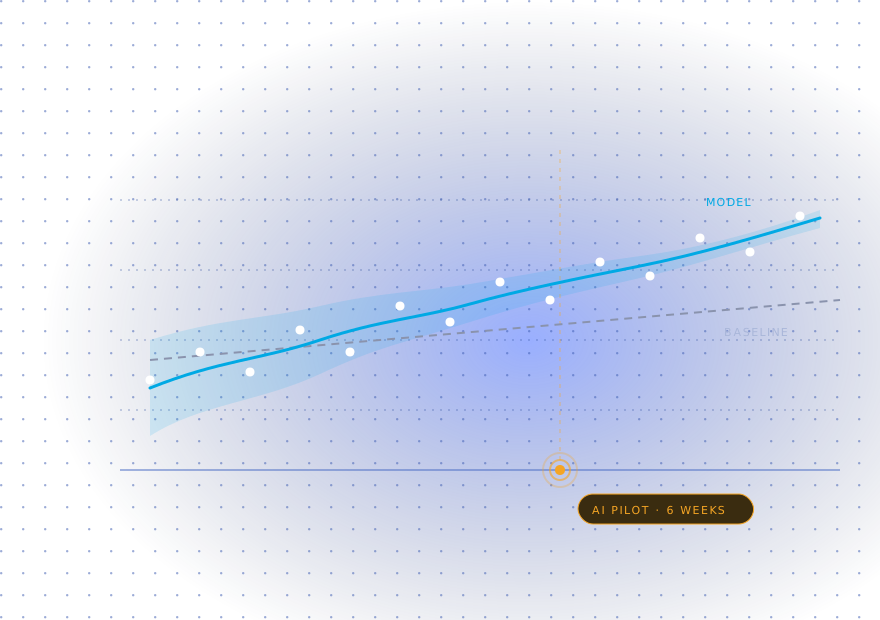
MTK first agrees the measure with the client and records the error of the current method as the baseline.

The model then runs on the client's data in a six-week AI Pilot and is judged against that baseline.

BaselineAI Pilot · 6 weeks

Related use cases

Use cases on MTK Predictive

View all use cases
  • MTK Predictive

    Demand forecasting

    Forecasts by product, channel and region for distributors and retailers, measured by forecast error against the current method.

  • MTK Predictive · MTK ERP

    Late-payment prediction

    Receivables ranked by payment risk so collections teams contact the right customers first, measured by days sales outstanding.

  • MTK Predictive

    Predictive maintenance

    Early warning of equipment failure from sensor data and maintenance history, measured by unplanned downtime.

Ownership and deployment

What the client owns and where it runs

  • Client ownership

    Historical data, trained models and their parameters belong to the client. Model templates are licensed from MTK.

  • In the client's cloud

    Models are trained and served in the client's cloud subscription, next to the data they use.

    or
  • Managed by MTK

    MTK hosts and operates the models in an environment it manages, with client data held in its own tenant.

FAQ

Questions about MTK Predictive

Why does a services company keep its own predictive models?
Because most forecasting projects start from the same questions and data. Templates let MTK spend pilot time on the client's data rather than on rebuilding a model.
Are the models ready to use as delivered?
No. Each template is trained and tested on the client's own history first. A model is used only after it performs better than the current method on an agreed measure.
How much history does a forecast need?
Enough to cover the seasons and events the forecast must handle. An early check of the available history shows what each model can support.
How accurate will the forecasts be?
MTK does not promise an accuracy figure in advance. Accuracy is measured during the pilot against the client's current method, and that result decides whether to scale.

A six-week forecasting pilot

Choose one forecast, agree how accuracy is measured and compare the model with the current method.